
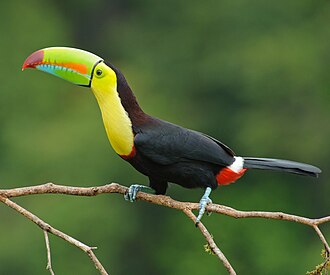
The keel-billed toucan, also known as rainbow-billed toucan or sulphur-breasted toucan, is a species of toucan native to southern Mexico, Central America and the far northwest of South America, and is found in tropical forests. It is the national bird of Belize.
Food and feeding
The diet of keel-billed toucans consists mostly of a wide range of fruit, such as Cymbopetalum mayanum (Annonaceae) and gumbo-limbo (Bursera simaruba), but may also include insects, eggs, nestlings, and lizards. The bill, surprisingly dexterous, allows this toucan to utilize a large variety of fruit that might not otherwise be reached. When eating the fruit, it uses its bill to dissect the fruit, and then tosses its head back to swallow the fruit whole.
Typically, the toucan eats off the ground, from mid-story to the forest canopy. Rarely, it may eat on the floor of the forest. The keel-billed toucan is possibly the first toucan observed eating carrion, by a team of researchers in 2018 in Costa Rica.
The toucan’s diet has an effect on the plants that it eats, as large seeds digested and vomited by the birds have a higher chance of sprouting than those which are not eaten.
Occasionally, the chestnut-mandibled toucan will follow the keel-billed toucan to a source of food, and then chase away the smaller bird.
Breeding
When courting, the birds will exchange fruit with each other.
The female keel-billed toucan lays 1–4 white eggs in a natural or already-made tree cavity. The male and female share in the caring of the eggs, both taking turns incubating.[10] The eggs hatch approximately 15–20 days after being laid. After hatching, the male and female again take turns feeding the chicks. When the chicks hatch, they have no feathers, and have their eyes closed for approximately 3 weeks. The chicks have adequately formed heel pads, which assist on the seed-covered bottom of the nest. The chicks stay in their nest for approximately eight to nine weeks while their bills develop fully and they are ready to fledge from the nest.
Keel-billed toucans can have as many as 3 broods each year.
Source Wikipedia